Saturday, April 9, 2016

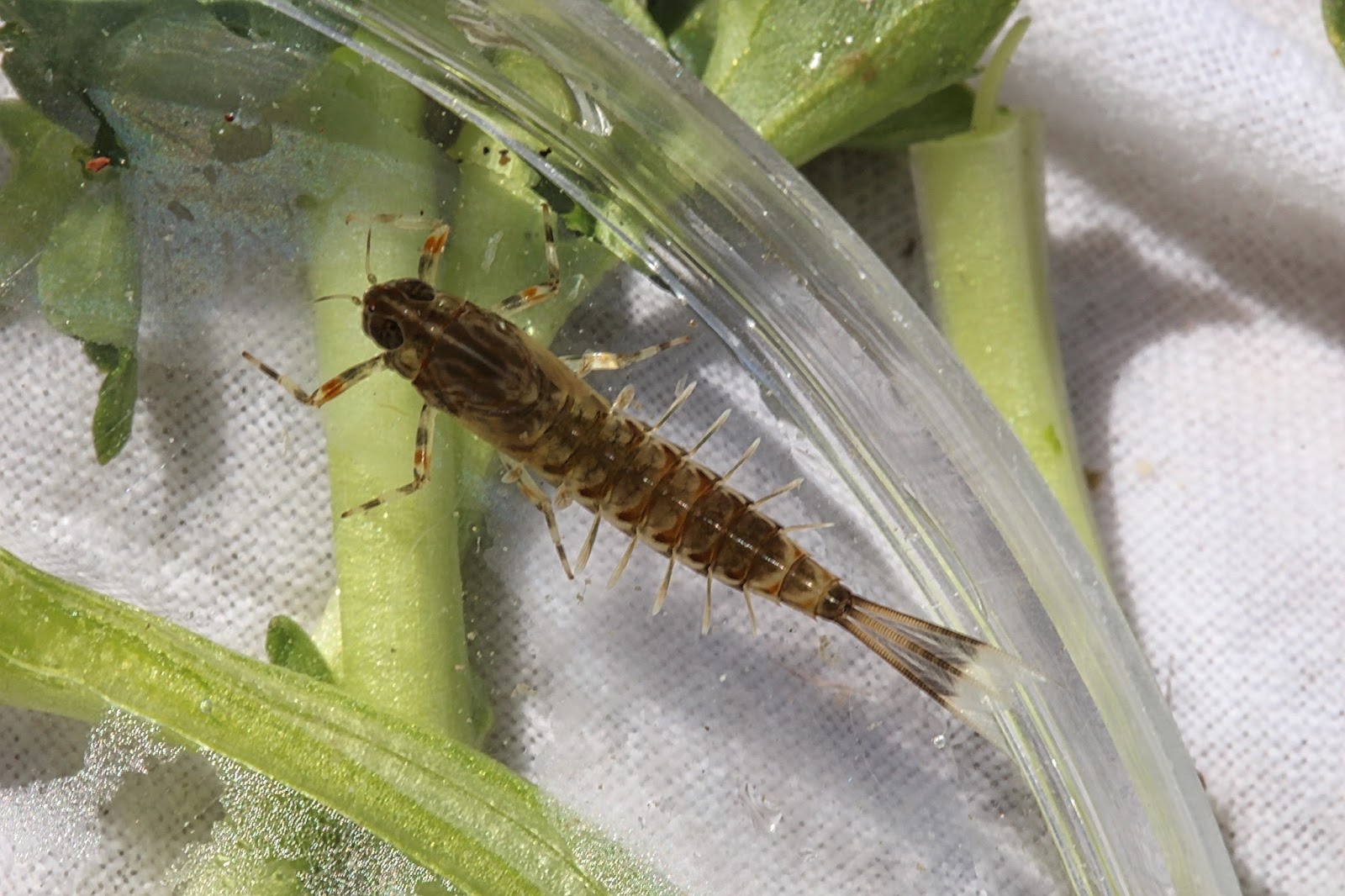
The Skwala: Large Springfly (Bitterroot River, Montana)


And this is why I was fishing in Montana last week.  The "Skwala hatch" was on.  It's a well-known hatch in the Missoula area, and the Bitterroot River is the place where most people go to fish it, and I had wonderful fishing there on the last day of March.  The scenery wasn't bad either!


The nymph in the photo at the top of the page is a female, the males are much smaller, and I regret not taking a photo of a male as well.  We saw some, but I had already put my camera equipment away.  The nymph in this photo measured 24 mm.

The most thorough description of the Skwala nymph is once again to be found in Stewart and Stark (Nymphs of North American Stonefly Genera, pp. 448-451).  The key features are these:

1. "Head dark with lighter M mark forward of anterior ocellus and incomplete mesal bar; 2 oval, light occipital spots inside eyes, broken with reticulate dark lines and bordered behind by narrow band of stout spinules."  These features are easy to see on our nymph, as are some "erect white, silky hairs behind [the] ecdysial suture of [the] head."


2. "Lacinia bidentate with tuft of setae on a low knob below subapical tooth and continuous inner row of marginal setae...terminal tooth about 0.4 times total outer lacinial length and subapical tooth about 0.6 times length of terminal tooth."  The "knob" below the subapical tooth is very distinctive, almost forming a shelf.  (Note that in my photo the tip of the apical tooth seems to be broken.)


3. "Long submental gills, projecting portion about 2.5-3.0 times as long as their basal diameter."  Yes.


4. "Pronotum dark with light lateral margins, light mesal band and light reticulate interior markings; complete row of short marginal spinules."


5. "Y-arms of mesosternum reach anterior corners of furcal pits."


6. "Abdominal terga brown with mesal and lateral pairs of small light spots; densely covered with intercalary setae and margined posteriorly with a closely set row of short, stout setae."  We can see all of those features in this photo.


Don't think we need anymore evidence to verify the genus ID.  It's a Skwala.


Regular readers might recall that I've found small Skwalas before, both in Montana and Oregon. The photo below was taken in Oregon in October, 2013.


There are two species of Skwala found in Montana -- S. americana and S. curvata.  Can we tell which one this is?  The answer is "No".  To distinguish the species, to begin with, we need a male nymph -- which is not what we have.  And, the males are distinguished by the relative size of the lobes on the terminalia.  We have no way to proceed, so we are left with our genus ID.  Good enough for me!

________________

But I'm now back in Virginia, and I hope to head up to the Rapidan River tomorrow.  Lots going on here at the moment.


Thursday, April 7, 2016

An Isogenoides Perlodid: but is it "colubrinus" (Blackfoot Springfly) or "elongatus" (Elongate Springfly)


I knew as soon as I saw it that I had not seen this stonefly before.  And it was BIG -- 25-26 mm.  But I was clueless about the ID, even the genus.  I had to key it out.  And for that I turned to our major source of information -- Kenneth W. Stewart & Bill P. Stark, Nymphs of North American Stonefly Genera (Plecoptera), pp. 403-406.

(Note: the "Key to Mature Nymphs of Perlodidae" in Stewart and Stark -- pp. 361-364 -- won't get you to Isogenoides.  The ID follows from couplets 19 to 20 to 22 to 23.  But none of the preceding dichotomous choices takes you to item 19.  I decided where to begin by matching my nymph with the anatomical features of Isogenoides illustrated on p. 405 (Fig. 14.28).)

1. "Body light brown or yellow with brown markings: intersegmental membranes cream to light yellow; antennae and legs yellow, cerci brown."  Stewart and Stark are using an I. zionensis nymph as their model.  Since that species doesn't occur in Montana, we can't be locked in by the colors.  Still, the intersegmental membranes on our nymph are, indeed, "cream to light yellow." (See the photo below.)

2. "Head with yellow M mark forward of anterior ocellus; ocellar triangle enclosing a brown spot; occiput with large yellow spots, enclosed by brown, well-developed row of occipital spinules, interrupted mesally."  All true.


3. "Lacinia triangular, bidentate with a distinct knob below subapical tooth."  Yes, and in their illustration of this, they show three, stout setae on that knob, just as we see in my photo below.


4. "Prominent submental gills, projecting portion about 3 times their basal diameter."  They're really big.


5. "Pronotum light brown with faint lighter reticulate pattern; a narrow anterior transverse dark band, posterior brown margin and light lateral margins."  Yes, pointed out in the photo above.

6. "Y-arms of mesosternum meet posterior corners of furcal pits; a distinctive median, longitudinal ridge connects fork of Y with a transverse ridge."  Here that is.  Note that the median ridge is very light.


7.  "Meso-metanota with pairs of large round anteromesal light spots and faint pattern."  Let's look at our diagnostic photo again.  I've pointed to those light spots with the four, short yellow lines, showing the four on the mesonotum.


8. "Abdominal terga light brown, somewhat darker anteriorly."  Those colors show up really well on the terga of a second, younger, nymph that I found.


Stewart and Stark also describe the setae on the legs and the cerci, but I don't think we need anymore.  It is an Isogenoides Perlodid nymph for sure.
__________________________

But can we go further?  Can we determine the species ID.  I think that we can, and I'll show you on what that is based.

To begin with, according to Stewart and Stark, there are only two species that occur in Montana: elongatus -- the Elongate Springfly -- and colubrinus  -- the Blackfoot Springfly.   John Sandberg suggested to me that for the stoneflies we find in Montana, I might take a look at the follow monograph: Richard W. Baumann, Arden R. Gaufin, and Rebecca F. Surdick, "The Stoneflies (Plecoptera) of the Rocky Mountains," Memoirs of the American Entomological Society, 31 (1977), pp. 1-208.  On p. 126, the authors provide us with a "Key to the Species of Isogenoides," and they provide the following couplets when it comes to the nymphs.

1. Conspicuous denticles present along margins on ventral cusps of both mandibles....2
    Denticles present along margin on ventral cusp of right mandible only....colubrinus

2. Body color dark brown ... elongatus
    Body color very light, almost yellow...zionensis

Since I. zionensis is out of the running, all that we have to do is look for denticles on ventral cusps of the mandibles.  As it turns out, denticles are present on both.

right mandible

left mandible


So, I'd say this little beauty was Isogenoides elongatus -- the Elongate Springfly.  One more thing in favor of this conclusion.  Among the places where this nymph has been found in Montana is Missoula County, and that's where I was, on the Clark Fork River.  I. colubrinus, on the other hand has not been found there, but it has been found in Lincoln County, home of the Blackfoot River.  Hence, the Blackfoot Springfly!

________________

Note: John Sandberg tells me that the key in Baumann et.al., isn't the greatest.  Best to call this one Isogenoides sp. (elongatus/colubrinus).


Wednesday, April 6, 2016

Isoperla roguensis?: Let's take a step back


In the entry I put up yesterday, I made the case for identifying this nymph as Isoperla roguensis.  Since then, I've been in touch with John Sandberg who has reminded me of how difficult species identification can be.   To wit, in this case, species identification depends on exacting examination of the lacinia using a compound microscope -- something I just cannot do.  It is not enough to go by pigmentation and pattern.  Moreover, provenance of this nymph has not been established in the state of Montana.  To date, it has only been found for sure in California and Oregon.

So, the nymph in the photo at the top of the page may or may not be I. roguensis.  It looks a lot like the nymph that Sandberg has identified in that way, but the jury is out.  If I have further word on this matter, I'll let you know.


Ameletus subnotatus: the "Brown Dun" (Montana, Bitterroot River)


Two weeks ago, as I anticipated my fly fishing trip to Montana, our guide sent me the following photo of a mayfly dun that had landed on his oar.

                                     (photo by John Herzer, Blackfoot River Outfitters)

He asked if I knew what it was.  I didn't, but I dug around and found an exact match on Troutnut.com (http://www.troutnut.com/hatch/140/Mayfly-Ameletus-oregonensis-Brown-Dun): Ameletus oregonensis, the Brown Dun.

I hoped that I might find A. oregonensis nymphs when I got to Montana, so I was pretty sure what I had when I found these critters in the Blackfoot and Bitterroot Rivers.


As it turns out, I was wrong -- but let's see how I arrived at that conclusion.  I found the answer in an article by Jacek Zloty and Gordon Pritchard, "Larvae and Adults of Ameletus Mayflies (Ephemeroptera: Ameletidae): From Alberta", The Canadian Entomologist (129), pp. 251-289.  Larvae are keyed out on pp. 256-257, with important illustrations of critical features in Figures 17, 18, 20, 23 and 28.
____________________
Zloty and Pritchard, pp. 256-257

"1.  Ganglionic markings present on abdominal sternites 2-8 (Fig. 18E).....2
       Ganglionic markings absent (Occasionally visible on sternites 7-8 or on sternite 8...3"

I had no idea what "ganglionic markings" looked like until I looked at that illustration (p. 279).  It's hard to explain.  There's a dark pod-shaped dot on the anteromedial edge of the sternites, with parenthetical marks -- ( )to each of its sides.  Here's a look at the sterna on our nymph.


No anteromedial dark spots, just a pair of light, anterolateral spots on each of the segments.   So, on to number 3.

"3. Posterior margin of abdominal sternites 6-8 with numerous spines (Fig. 28A, B) .... 4
      Posterior margin of abdominal sternites 6-8 without such spines.....6

There are spines on the posterior margins, but let me show you my photo later.

"4. Basal two-thirds or middle one-third of caudal filaments with alternating dark and light rings every two or three segments; mesal gill extension of middle gills about 50% of gill blade width (Fig. 23F); colour pattern of abdominal tergites 8 and 9 as in Figures 19C and 20B; final-instar larvae occur early in the season (April to June)....5
     Caudal filaments without alternating dark and light rings....6"

Here's a look at the caudal filaments, and yes, the middle one-third of the caudal filaments do have alternating dark and light rings,


and the colour pattern matches what we see in Figures 19C and 20B.  Terga 8 and 9 are light, as are terga 1-5: 6 and 7 are dark.


On the "mesal gill extensions of the middle gills...


I'm not sure what is intended.  Still, the gills on our nymph are an exact match for the gill pictures in Fig. 23F, so I guess we're good to go.  On to item 5.

"5.  Posterior margin of abdominal sternites 6-8 with numerous large spines at the middle (Fig.        28A)... oregonensis
     Posterior margin of abdominal sternites 6-8 without large spines at the middle but with numerous small spines laterally (Fig. 28B) ....subnotatus"

We find the latter on on our nymph.  I couldn't get a very good photo of this, but I hope you can make out the tiny lateral spines.

__________________

Ameletus subnotatus.  At 13-14 mm, it's a pretty big nymph.


This is a mayfly that is found from East to West in Canada, but in the U.S., it's only been found in CA, CO, MT, UT, and WY.   Oh, and with the similar dorsal pattern of A. subnotatus and A. oregonensis, I'm not surprised that the duns look exactly the same.
_____________

P.S.  Donald Chandler has posted a photo of Ameletus subnotatus at: http://www.discoverlife.org/mp/20p?see=I_DSC484&res=640.  On his nymph, the dark bands on the caudal filaments are basal, not in the middle


Tuesday, April 5, 2016

The Perlodid stonefly, Isoperla roguensis (Montana, Clark Fork River)


The Isoperlas I found last week in Montana in the Blackfoot and Clark Fork Rivers were Isoperla roguensis.  Species ID is possible using an excellent article by John Sandberg -- "The Isoperla of California (Plecoptera: Perlodidae); larval descriptions and a key to 17 western Nearctic species," Illiesia, 7(22): 202-258.  I am grateful to Steven Beaty for sending this to me.  Sandberg's very detailed description of I. roguensis can be found on pp. 244-246.  It includes color photos of the nymph and the features of the lacinia.

"Male larva.  Body length of mature larva 9-12 mm."  The nymph in my photo at the top of the page was a full 12 mm.

For description of the top of the head, let's use the following photos.


"Dorsum of head with contrasting pigment pattern and fine dark clothing setae, anterior frontoclypeus margin unpigmented...posterior ocelli with partially enclosed large light areas along outer lateral margins; interocellar area variable , from completely dark to partially light."  (This one is completely dark.)  "Occiput with irregular spinulae band extending from below eye to near median epicranial suture."  You can't see the entire band in my photo, but I've noted the direction of that band from the base of the eye to the epicranial suture.  I'll try to get a better photo tomorrow.  

"Lacinia bidentate...marginal setae initially long-stout and widely spaced, last few shorter and widely spaced, blending into and difficult to differentiate from dorsal and ventral surface setae." Sandberg's description of the lacinial features is very detailed -- I've just touched on the critical features.  (In Sandberg's photo, there seem to be 6 marginal setae.  Think that's true with this specimen as well.)


"Prontum with median light area occasionally with a thin central indistinct brown band bordered by wide dark irregular pigment bands."


For sure.

"Abdominal terga variable, usually with two distinct longitudinal dark stripes; wide light median longitudinal band sometimes bisected by faint, light brown longitudinal median band; lateral pair of dark longitudinal stripes usually not extending to lateral margins."  Good view of those stripes on this small nymph (10 mm) that I found in the Blackfoot.

_________________

Isoperla roguensis -- the "Rogue Stripetail" -- but fly fisherman go by the name of the hatch, the "Yellow Sally."  It's a big hatch in the rivers in the Missoula area, occurring in June and July.  Hope to see it some day!

Sunday, April 3, 2016

A Montana Sampler: Lots of New Insects to ID


It was a very nice trip.  The fishing was great, the scenery was -- well, have a look at that photo! -- and I found a lot of new insects, all of which I have to ID.  That will take me awhile, so this is a "taste" of what's to come.

1. My favorite -- a new species of Isogenoides (Perlodid stonefly).


A real beauty.

2. A second Perlodid stonefly, a Skwala.  We saw the nymphs and the adults.   The rivers around Missoula are famous for the Skwala hatch at this time of year.  I was there to fish the "Skwala hatch".


3.  Another Perlodid, an Isoperla this time.  The "Yellow Sally" hatch can't be far away.


4. And a final Perlodid stonefly, a very young Kogotus.


5. Mayfly number 1 -- a Western Ameletus.  I'll ID this one in my next entry: it's A. oregonensis.


6. A new Cinygmula flathead.


7. A second Heptageniidae, this one a Rhithrogena.


8.  And one little caddisfly larva, one that we've seen before (see 5/1/14), Dicosmoecus gilvipes, the "October Caddis".


Fun, fun, fun.  Sure love finding new things.