Wednesday, January 26, 2011

The "Long-horned Case Maker Caddis" (family: Leptoceridae)


While the Limnephilidae (Northern Case Maker) caddis is the largest caddisfly family in North America, worldwide, the largest number of caddisfly species (1300+) is found in the Leptoceridae family (Long-horned Case Maker).  In this country, six genera account for only 100 species of Leptocerids. (See Thomas Ames, Caddisflies: A Guide to Eastern Species for Anglers and Other Naturalists, p. 190.)

The Leptocerid is, for the most part, a "warm water" caddisfly larva, found in lakes and ponds and large streams and rivers: they prefer habitats with bottom vegetation out of which many of them make their cases.  Thus, it is no surprise that in the data that StreamWatch has assembled over the years, this is a caddis that is primarily found in the Rivanna River itself -- in all of the mainstem sites that are sampled -- sometimes in fairly large numbers (it is, however, on occasion found elsewhere).  Most are found in late spring and mid-summer: this is a larva that hatches from mid-summer through early fall, and during that period, the adult form of this caddis can provide exciting fishing for fly fishermen.

Whence the name "Long-horned"?  It comes from the length of the larval antennae.  Whereas most caddis larval antennae can hardly be seen, even with the aid of a microscope, the "Long-horned" antennae are easy to see at the front of the head.
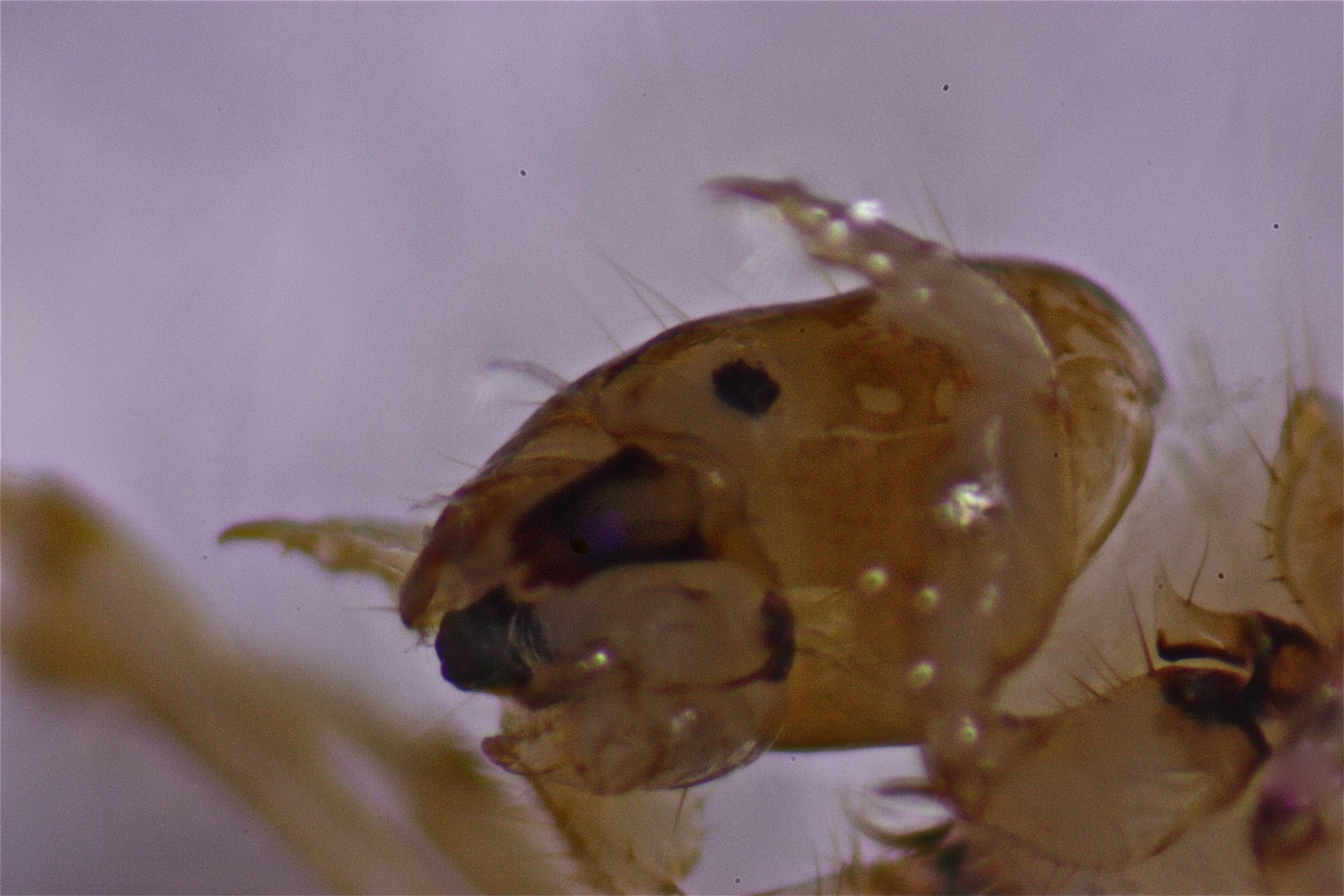

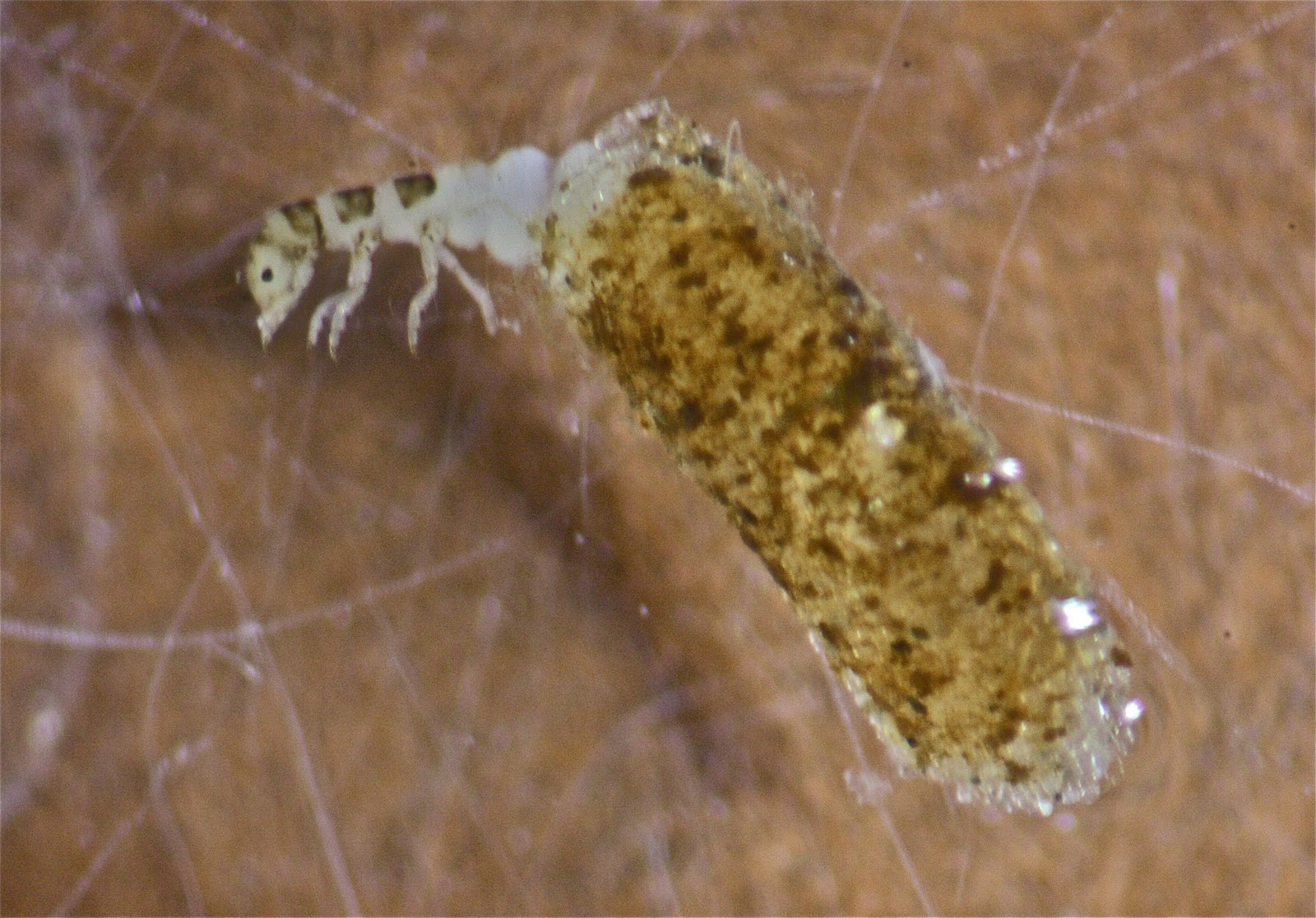
In this photo, the antenna is the clear, spike-like projection that sticks out from the head to the left of the eye (from the viewer's point of view).    There is one other feature that helps us to pick out a larva in this particular family from all other caddisfly families:  the hind legs are quite a bit longer than the front and middle legs.  Have another look at the picture posted at the top of the page.  All three pairs of legs can easily be seen in this photo.


Of the six Leptocerid genera keyed out in Peckarsky, et.al., Freshwater Macroinvertebrates of Northeastern North America, p.114),  I have seen only three, to date, in the samples done in our streams:  Ceraclea, Oecetis, and Nectopsyche.   Unfortunately, I have no photos of Ceraclea.  I've only seen two in the two years that I was with StreamWatch, neither of which is in my reference collection.
I can say that Ceraclea larvae are somewhat unique in this caddisfly family.  The antennae on these larvae are not terribly long:  but in their stead there are two, black, curved lines on either side of the mesonotum (dorsum) that help us with identification.

Oecetis larvae often make cases of pebbles, as in the sample below.  The photos show the larva both in and out of its case.


(This larva, by the way, was not found in a large river.  I found this this summer in Lickinghole Creek near Crozet.)    The long maxillary palpae set this genus off from all other members of the Leptoceridae family.   In the photo below, the maxillary palpus is the dark, burnt orange spike sticking out in front of the head of the larva (directly below the antenna).


The other Leptocerid genus I've seen in our streams -- Nectopsyche -- is the one that I normally think of when I think of this type of caddis.   The cases are always (almost always?) attached to a sturdy stem of vegetation, one that's longer than the case itself.  Here are two pictures of this easily identified case, one with the caddis inside its case, the other with the caddis outside.


How do we know this particular genus?  Well, the case helps a lot -- though there is another genus (Mystacides) -- that builds a case that could be mistaken for this.   One of the features that helps to identify Nectopsyche are the dark, sclerotized bands that stick down from the orange circles that form the lateral humps (note: the "Long-horned" does have a dorsal and two lateral humps on the first abdominal segment, but they are often not very distinct).   This feature we can see in the photo below.


(On this point, see Glenn B. Wiggins, Larvae of the North American Caddisfly Genera (Trichoptera), pp. 168-169.)

Tuesday, January 25, 2011

Stream Report: Buck Mt. Creek

Some interesting pictures for folks to compare.  Below is a photo of what was for me the first Uenoid caddisfly of the season: Buck Mt. Creek, December 11.  The case was very small.


Here is a Uenoid that I found today.


Note the larger pebbles on each side of the case: this is what we expect to see  in a mature Uenoid case.
I should add that I saw a number of Uenoid cases lining up in a row in preparation for pupation.

The other thing to compare -- three pictures I've taken at Buck Mt. Creek of large winter stoneflies, genus Strophopteryx (I'm no longer seeing any Taeniopteryx large winter stones, and I only saw two small winter stoneflies today).  The pictures, in order, were taken on 12/28, 1/6, and today, 1/28.


Note how the wingpads have changed in the more mature nymph that we found today.  These stoneflies will get even larger, and I would expect to see Strophopteryx nymphs through next month and maybe beyond.

Monday, January 24, 2011

Micro Caddisflies (family: Hydroptilidae)


The Micro Caddisfly (family: Hydroptilidae) -- also known as the "Purse case-maker" -- is the smallest macroinvertebrate that we find in our samples -- or better yet, try to find!  The size of this larva and its case may best be appreciated by looking at the photo below, in which it is placed next to a grain of rice; the rice grain is about 1/4" long.


Let me admit right away that I myself never succeeded in finding one of these on a net.  The only person I knew that could do it was Rose Brown, the Program Manager of StreamWatch: she is exceptionally talented, probably has more experience in sampling than all the rest of the volunteers put together, and she can always find insects on nets long after the rest of us have given up!

The Micro caddis gets its alternate name of "Purse case maker" from the fact that its case -- normally made of fine grains of sand as in the photos above -- is actually made of two dome-like sides that are then sealed together.  However,  the "Purse case-maker" is only a "case-maker" in a qualified way (we noted that this was true, as well, for the Saddle case-maker: see the entry for 1/15/11.)  Unlike true case makers, the Micro caddis does not build its case until its final instar, as it prepares for pupation: until then, it is "free-living".   In fact, Wiggins and others do not see this as a "portable case maker"at all.  Rather it belongs with the "Free living caddis"(Rhyacophilid) and the Glossosomatid (Saddle case-maker) in the primitive group "Spicipalpia."  ("Spicipalpia," and I quote Glenn Wiggins on this, alludes to the "the pointed apex of the terminal segment of the maxillary palps of the adult insects." [Wiggins, Caddisflies: The Underwater Architects, p.107])


Fortunately, Micro caddisflies are normally found in their cases.  But when they are not, they are still easily identified by two distinct features (if we need anything more than their miniature size!).   Like the "Common Netspinner," the pronotum, mesonotum, and metanotum -- the three sections that follow the head -- are all "sclerotized" (i.e. they're shiny and brown, not fleshy).  And the other feature that gives this larva away is the unusually large abdomen which is much thicker than the thorax and head.

This is a caddis that StreamWatch volunteers do not find very often.  A few have been found in Long Island Creek in Fluvanna, and a few have been found in the Moormans River.  But without any question, the Rivanna River itself provides the habitat they seem to prefer, and even beyond that, most have been found at two sites below Palmyra.

Saturday, January 22, 2011

Wierd Looking Mayflies: "Common Burrowers" and "Armored Mayflies"


There are a couple of mayflies that are hardly ever seen in our watershed.  In fact this one -- the "Common Burrower" (family: Ephemeridae) was seen for the first time last year.   And, it was found in two very unlikely places -- the upper reaches of the Doyles River, and the Albemarle County reference site, both clean, cold, rocky upland streams with very little silt and sand.  That is not the habitat this insect prefers.  It does like cold water; but it inhabits slow-moving pools, normally in larger rivers.


The burrower nymphs use their tusks and robust front legs to dig out "U" shaped tunnels in gravel and sand.  There they stay during the day, emerging at night to forage.  From the two-pointed projection in front of its head, we know that the genus of this particular nymph is Ephemera: whether it's E. guttalata (the "Green Drake") or E. varia (the "Yellow Drake"), I'm not really sure.  But from pictures I've seen, and the shape of the tusks, I'd go with the latter.

The "Common Burrower" genus and species preferred by fly fisherman -- especially those who live in New England and the upper Midwest -- is Hexagenia limbata.   This hatches into one of the largest mayflies we see in the East, one sometimes mistakenly called the "Michigan caddis."  When I lived in Vermont, we simply called it the "Hex" hatch.  This is a large yellow mayfly that when it pops to the surface looks like a small sailboat, and the Trout simply go nuts.  Unfortunately, they tend to hatch right at dark, so you're not always sure where to cast.


There is another burrower that I take it is found in the East -- but I've never seen it.   This the "Hacklegill mayfly" (family: Potamanthidae) -- pictured in the photo above.  For fly fisherman, it's the "Golden Drake".  This would be found in the warm, silty waters at the edges of rivers -- places where stream monitoring groups rarely sample.  But it would be worth checking the Rivanna, or even the James, sometime to see if they're there.   The nymph in the photo above travelled back to Virginia from the Clark Fork River near Missoula, Montana, safely stored in my luggage after my annual fishing trip.


Finally, the other "wierd" mayfly that is seen only rarely in our watershed streams is the "Armored mayfly" (family: Baetiscidae).    StreamWatch occasionally finds them in its reference streams, and I believe one was found last year in Preddy Creek near Ruckersville.    It's one strange looking critter!
(And it's of no interest to fly fishermen whatsoever.)  It's distinguishing feature is the large carapace that completely covers the thorax and most of the abdominal segments, and thus all of the gills.

Friday, January 21, 2011

The Case-maker Lepidostomatid (family: Lepidostomatidae)


This may be my favorite case-making caddis: probably for a number of reasons.  To begin with, they're normally found in the kinds of streams to which I like to go: small, upland, cold water streams -- the kinds of streams in which Trout can often be found!  But I also love their "teddy-bear" heads (see below), and the cases they make can be works of art.


The case made by the Lepidostomatid (there is no "common" name for this insect, by the way) is normally shaped like the one in this photo: it's four-sided and square, made of neatly squared pieces of leaves and bark, and at the top, there are often "projections" added on at least one side of the case (sometimes on two or three sides).  Presumably, these are there for protection; i.e. the larva can quickly hide its head when it has to.  But there are other cases we find on occasion -- spiral cases made out of sand.  This type of case is normally made by larvae in early instars; and when the larvae grow and mature, they often top off those cases with squared off pieces of bark (as though they finally realize what their cases are supposed to look like!).  Here are examples of the cases I mean.


And a few more to compare.


How do we know when the caddis we've found is a Lepidostomatid?  Well, if it's in its usual four-sided case, you can be pretty sure that that's what you've got.  If it's out of its case, or if the case is the little one made purely of sand, you'd better go back to your lab and get the microscope out.

There are two features that you'll be hoping to find.  1) This is the only case-making caddis larva that has only two humps, these on the sides of the first abdominal segment.  Recall that most case-makers have three (the third one on the back of the larva), while the "humpless" caddis (Brachycentridae) has none.  So, if the lateral humps are clear and no dorsal hump is present -- you've got a Lepidostomatid.  (Note the "nipple" like humps on the sides of the larva below.)


If you need further verification, get ready to squint.  The Lepidostomatid is the only caddis with its antennae located directly in front of its eyes.  But the antennae are extremely small, and they're hidden away inside a light colored dot:  it's the dot that you have to look for.  See if you can find it in the photo that follows.


When I worked with StreamWatch, this is a caddis we normally found in our very best streams, those that were deep in the woods: our reference sites (both in Albemarle and Fluvanna Counties), the upper reaches of Buck Mt. Creek, the upper reaches of the Doyles River, and on occasion in the Moormans.  It has, after all, a tolerance value of 1.  But we also found it in places that always surprised me: for some reason we consistently ran into some in the sites that we sampled on the Rivanna River itself.  This is one of those anomalies I cannot explain.


(Photo of a live caddis in a petri dish taken at the Rapidan River.)

Thursday, January 20, 2011

Fingernets (family: Philopotamidae) and Trumpetnets (Polycentropodidae)


Seven North American caddisfly families are collectively known as "netspinners," or "fixed retreat makers" (vs. the "portable case makers").  Only three of these families live in our streams: the "common netspinners," the "fingernet netspinners," and the "trumpetnet netspinners".   Since we've already discussed "common netspinners" (family: Hydropsychidae) in an earlier entry (1/5/11), the focus here will be on the fingernets and the trumpetnets.  (Note: apparently two other netspinner families are found in other parts of Virginia -- Dipseudopsidae and Psychomyiidae -- but I don't think they've been seen, so far at least, around here.

Fingernets (family: Philopotamidae) are called "fingernets" quite simply because they make a net out of silk that's a long thin tube, that sort of looks like a finger.  This they attach to the bottom of a rock, open end facing upstream.  They live at the bottom end of the net and let their food come to them, every so often "cleaning" the net.  If you lift up rocks to see their nets, you're out of luck.  The net immediately collapses into a small pile of sandy, silky goo (in which you might see something wiggle!).

The fingernet caddis is easily recognized even by novice samplers, mainly because of its color.  It's orange, or yellow, or pale yellow, and the head is always burnt orange.  It also sports a "black collar;"  there's a black line that crosses the top of the body right behind the pronotum.   We find them in almost all of our streams -- some more than others -- and at almost any time of the year.  But with a family tolerance value of 3.0, they can be scarce or non-existent in our very poor streams.

There are three fingernet genera, and we find all three in our streams.  Without any question, the genus we find in almost all cases is the genus Chimarra.  This is the most tolerant of the three, assigned, by some, a TV of 2.8.   The distinguishing feature of this genus is readily visible with a microscope, and if the larva is big enough, it can be seen with the naked eye (it's visible in the photo at the top of the page).
Chimarra larvae have a prominent notch in the frontoclypeal apotome (i.e. in the leading edge of the head).  Take a good look at this photo.


Here the membranous labrum (which is "T" shaped) projects between the mandibles, and behind that is the leading edge of the top of the head.  The "notch" could hardly be clearer.

The second genus, Dolophilodes, is less tolerant of stream impairment (with a TV of 1), and to be honest I've only seen this larva in two of our local streams.  One is the Whippoorwill Branch of the Mechums River; the other, the Rapidan River.  The frontoclypeal apotome in this case does not have a notch -- but it is not completely even or symmetrical.  I hope this is clear from the picture below: the edge of the head bulges slightly on the left side (from the point of view of the larva).    (Note that the mandibles are closed in this photo.)


Chimarra and Dolophilodes larvae, I think, also differ slightly in appearance: the Chimarra head is more elongate and narrow when seen from the side; the Dolophilodes head more rounded.  (As in the photos below.)


The third fingernet genus, Wormaldia,  is one that I've seen only once -- and I don't have a picture to show you.  It is the most intolerant of impairment (TV of 0.4) and thus will only be found in very clean streams.  We found one last fall at one of the StreamWatch reference sites, and it is, as it should be, being kept in the StreamWatch reference collection.  The distinguishing mark?  The frontoclypeal apotome (leading edge of the head) is completely symmetrical -- no bulges, no notches.


The trumpetnet caddis (family: Polycentropodidae) makes a net in the shape of a trumpet -- or maybe a funnel -- i.e. it's wide at one end and narrow at the other.  This is attached to the base of a rock and funnels bits of food to the larva at the base of the net.  This is a caddis we do not see too often.  And, it is very difficult to distinguish this one in the field.   Unlike the "common netspinner," it has no frilly gills on the belly, and unlike the "fingernet caddis," it is not yellow or orange -- it tends to be tan in color.   When in doubt, samplers should preserve this kind of larva for lab identification.  Here is a photo of a specimen that's been preserved.


This family has two distinguishing features.  1) The head is almost always covered with grayish dots (these are known as "muscle scars").  And 2) the fore-trochantin -- sort of the "shoulder blade" of the first arm/leg is pointed and sticking forward, sort of like the edge of a knife.  Here is a close-up of that particular feature.


One last item of interest on the "trumpet net" caddis -- there is one genus that is "opportunistic" in its feeding habits.  While it relies mostly on bits of organic matter that flow into its net, if it senses movement of a small nymph or larva moving over its net, it will rush out (well, not sure "rush" is the right word to use!) and eat it for lunch.  This is the genus Polycentropus, and this is precisely the genus we have in our streams.   How do we discover this genus?  Look for the "X": there is a very clear "X" on the dorsal plate of the anal proleg (obviously, you can only see this through a microscope.)


Wednesday, January 19, 2011

Stream Report: The Rapidan River (Madison County)


The Rapidan River is not in the watershed of the Rivanna River.  Still, it's a beautiful stream coming out of the National Park, and north of Wolftown, the drive goes through some gorgeous country.  And,
there are lots of insects in this one, many I don't see anywhere else.

The day's inventory:  1) lots and lots of flatheaded mayflies, genus Epeorus -- there will be a very good "Quill Gordon" hatch here in March and April!  2) I found some Stenonema flatheaded mayflies as well;
3) a few small winter stoneflies; 4) a lot of large winter stoneflies -- all genus Taeniopteryx; 5) lots of "Humpless" caddisflies (Brachycentridae); 6) a few Glossosomatids (Saddle case makers) and a few Uenoid case makers as well; 7) two common stoneflies -- genus Acroneuria; 8) a small minnow mayfly; 9) a brushlegged mayfly; 10) a prong-gilled mayfly; 11) and this spectacular (photo above) spiny crawler mayfly (family: Ephemerellidae)! 12) I also found some netspinners and one fingernet caddis -- genus Dolophilodes.  This is not a genus we normally find, and I'll post an entry on fingernets shortly.

Another treasure today was this HUGE Giant stonefly.  This was 1 3/4" - 2" long: and if you doubt the length, note the size of the large winter stonefly in the top of the picture!


My fly fishing books tell me this will be hatching sometime this spring -- but he already looks fully ready to crack open that case and fly away!

A few more photos.  The humpless caddisflies that I found were especially colorful -- both the larvae and the cases.  An example below.  This was a big one: the case was 3/4" long.


I put several Glossosomatids on my petri dish to get some photos and witnessed something I didn't expect to see.  This one couldn't resist putting his head out from under the front of his case to peak around.


Finally, one of my main reasons for making this trip was to look for Lepidostomatids.  Lepidostomatids are case making caddisflies that we normally only find in this kind of stream -- mountainous, small, and well forested.   And this is the time of year they're around.  I've been wanting to write a short piece on this lovely larva, but I wanted to get a live shot.  As you can see, I was successful.  More to come on this later.