Tuesday, April 5, 2016

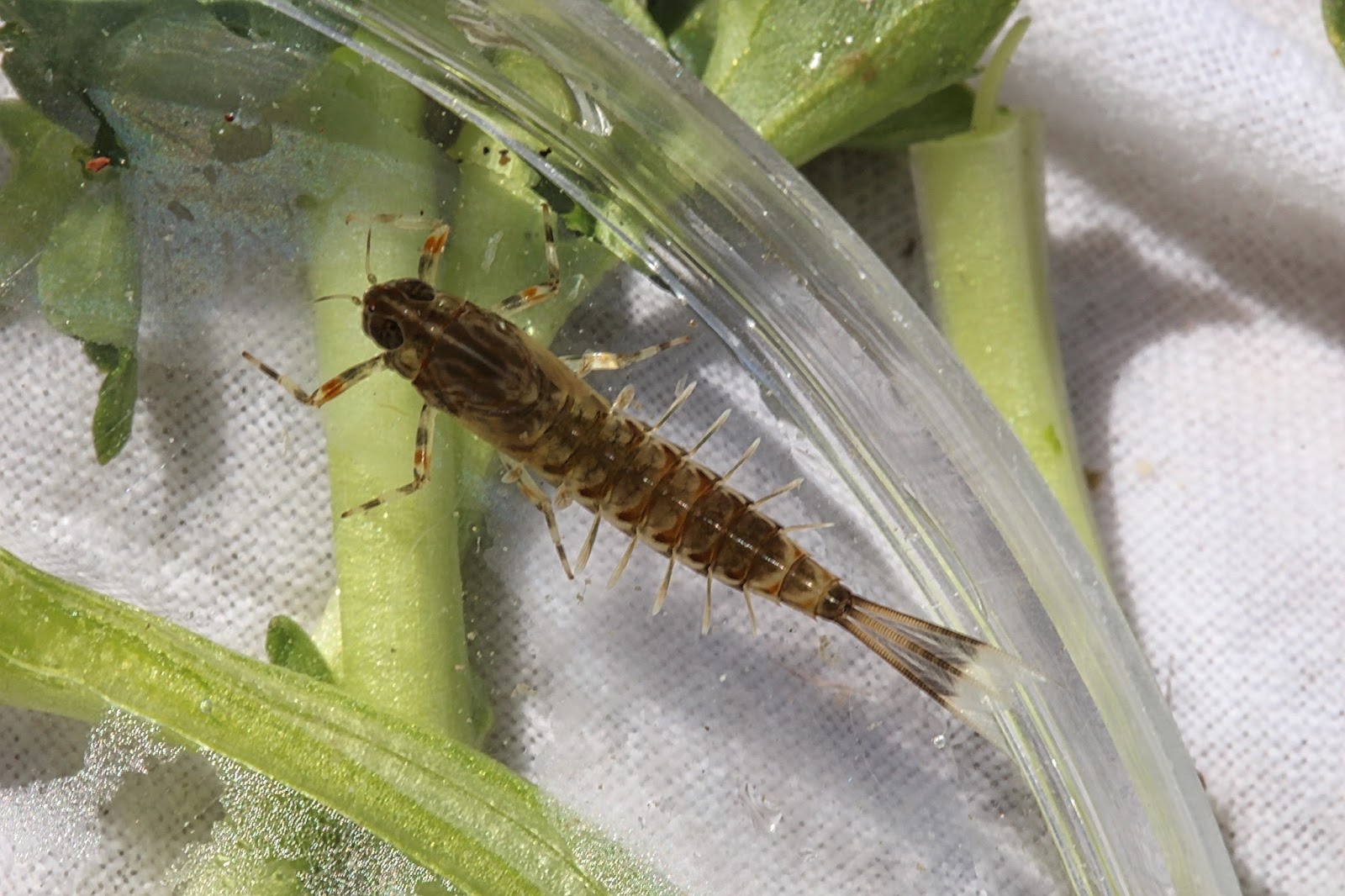
The Perlodid stonefly, Isoperla roguensis (Montana, Clark Fork River)


The Isoperlas I found last week in Montana in the Blackfoot and Clark Fork Rivers were Isoperla roguensis.  Species ID is possible using an excellent article by John Sandberg -- "The Isoperla of California (Plecoptera: Perlodidae); larval descriptions and a key to 17 western Nearctic species," Illiesia, 7(22): 202-258.  I am grateful to Steven Beaty for sending this to me.  Sandberg's very detailed description of I. roguensis can be found on pp. 244-246.  It includes color photos of the nymph and the features of the lacinia.

"Male larva.  Body length of mature larva 9-12 mm."  The nymph in my photo at the top of the page was a full 12 mm.

For description of the top of the head, let's use the following photos.


"Dorsum of head with contrasting pigment pattern and fine dark clothing setae, anterior frontoclypeus margin unpigmented...posterior ocelli with partially enclosed large light areas along outer lateral margins; interocellar area variable , from completely dark to partially light."  (This one is completely dark.)  "Occiput with irregular spinulae band extending from below eye to near median epicranial suture."  You can't see the entire band in my photo, but I've noted the direction of that band from the base of the eye to the epicranial suture.  I'll try to get a better photo tomorrow.  

"Lacinia bidentate...marginal setae initially long-stout and widely spaced, last few shorter and widely spaced, blending into and difficult to differentiate from dorsal and ventral surface setae." Sandberg's description of the lacinial features is very detailed -- I've just touched on the critical features.  (In Sandberg's photo, there seem to be 6 marginal setae.  Think that's true with this specimen as well.)


"Prontum with median light area occasionally with a thin central indistinct brown band bordered by wide dark irregular pigment bands."


For sure.

"Abdominal terga variable, usually with two distinct longitudinal dark stripes; wide light median longitudinal band sometimes bisected by faint, light brown longitudinal median band; lateral pair of dark longitudinal stripes usually not extending to lateral margins."  Good view of those stripes on this small nymph (10 mm) that I found in the Blackfoot.

_________________

Isoperla roguensis -- the "Rogue Stripetail" -- but fly fisherman go by the name of the hatch, the "Yellow Sally."  It's a big hatch in the rivers in the Missoula area, occurring in June and July.  Hope to see it some day!

Sunday, April 3, 2016

A Montana Sampler: Lots of New Insects to ID


It was a very nice trip.  The fishing was great, the scenery was -- well, have a look at that photo! -- and I found a lot of new insects, all of which I have to ID.  That will take me awhile, so this is a "taste" of what's to come.

1. My favorite -- a new species of Isogenoides (Perlodid stonefly).


A real beauty.

2. A second Perlodid stonefly, a Skwala.  We saw the nymphs and the adults.   The rivers around Missoula are famous for the Skwala hatch at this time of year.  I was there to fish the "Skwala hatch".


3.  Another Perlodid, an Isoperla this time.  The "Yellow Sally" hatch can't be far away.


4. And a final Perlodid stonefly, a very young Kogotus.


5. Mayfly number 1 -- a Western Ameletus.  I'll ID this one in my next entry: it's A. oregonensis.


6. A new Cinygmula flathead.


7. A second Heptageniidae, this one a Rhithrogena.


8.  And one little caddisfly larva, one that we've seen before (see 5/1/14), Dicosmoecus gilvipes, the "October Caddis".


Fun, fun, fun.  Sure love finding new things.

Wednesday, March 23, 2016

Just a beautiful insect: fully mature, Perlodid stonefly, Helopicus subvarians


This morning I was off to Buck Mt. Creek where the water was still pretty high.  Still, it's the time when we find Perlodid stoneflies, and Buck Mt. Creek has proven very productive.
 

This is Helocipus subvarians, a stonefly that I first identified on 4/2/11.  It's one of the largest Perlodid stoneflies that we find in local streams: this nymph measured 22 mm.  I think I'm right in saying that I've only seen it in Buck Mt. Creek and the Doyles River.  Tolerance value is 1.2.   This nymph is very mature, in fact, I thought it might hatch in my tray while I was taking these photos.
Most striking, how dark the head is both in front of and behind the black transverse band.


On less mature nymphs, even those with dark wingpads, the front of the head is usually orange.  I.e.,


Nice find.  Such rich colors.
_________________

My other discovery today was a very small Perlodid stonefly -- ~ 5 mm -- the one we ID at the moment as a variant form of Isoperla orata.


As I've noted before, the patterns of the two (main form and variant form) are quite distinct.  On the variant form of Isoperla orata, there two dark spots behind the ecdysial suture, and the bottom of the notch at the front of the head is straight across.


But on the main form of the species, the dark spots are missing, and the bottom of the notch at the front of the head is rounded.


Also, Isoperla orata is uncommon and only found in very clean mountain streams.  I've never seen it in Buck Mt. Creek, only at the Rapidan River.  And while the variant form can be found side-by-side with the main form, it is also found in streams like Buck Mt. Creek and the upper Doyles River, good streams, but not the equal of the Rapidan River.   For more on this point, see the entry on habitat and species variation posted on 8/26/15.

___________________

Hope to get up to Entry Run in Greene County this weekend.  Next week, it's off to Montana!


Wednesday, March 16, 2016

Some pictures from the Rapidan River


Not much to report today.  But I was pleased with these photos, so I thought I would post them.  That's the flatheaded mayfly Epeorus pleuralis.  It's very common at this time of year in cold water streams -- like the Rapidan River.  Fly fisherman, if you're headed that way, take some Quill Gordon imitations.  These nymphs are on the bottoms of rocks, and they're numerous.  Should be hatching now anytime.


______________________

E. pleuralis on the bottoms of rocks, and Isoperla montanas crawling around in the leafpacks.  Must be March!  Isoperla montana is part of the "Isoperla kirchneri complex" -- see the entry posted last year on 9/3 --  and it's the most common Perlodid stonefly that I run into: March to mid-April.  While I've never fished the Rapidan River, there must be a prolific hatch of "Yellow Sallies" up here, and it too will be happening soon.


_________________

I was really hoping to see a mature Isogenoides hansoni nymph, as I did in March, 2011,


but no luck today.  I'll be back before the end of the month.  It's one of the rare insects that we find in this stream, and I don't want to miss it.
__________________

P.S. if you're editing photos with "Photos" on Macintosh, be sure to buy and install the extension "intensify."  I use "Photos" to crop and straighten -- that's it.  "Intensify" is the software to use.

Friday, March 11, 2016

The "rare" one: caddisfly larva, Pseudostenophylax sparsus


This is the second time I've found this species of caddisfly larva.  The first was 6 or 7 years ago at the "Patricia Byrom Nature Preserve" in the Blue Ridge in a very small, very clean stream at high elevation.  But, if you look back to the entry of 3/12/14 you'll see that my friend in Sugar Hollow, has found them in a  tiny spring seep on her land.  Right at the base of this pipe.


This "pool" is 1-2' feet square, and below this you won't see flowing water, just wet leaves and mud.  But that's where this species lives.  Steven Beaty, "The Trichoptera of North Carolina," p. 84: "Occurs in seeps and temporary streams.  A late winter-early spring species.  Rare."  It will hatch as a "Dark brown summer sedge" -- Thomas Ames, Caddisflies, p. 250-251 -- but no trout to eat them in this little pool!


There is only one species of Pseudostenophylax that lives in this part of the country -- P. sparsus.  Pseudostenophylax species are described this way by Wiggins: "...in all species mesonotal setal areas are confluent through sa1 to sa2 to sa3, and there is a transverse band of setae between the metanotal sa2 sclerites.  Sclerotized parts of the head and thorax are uniform reddish or yellowish brown, broken only by muscle scars.  Abdominal gills are single.  Length of larva up to 16mm.  Larval cases are contructed mainly of small rock fragments, the exterior uniform in outline.  Length of larval case up to 19mm."  (Glenn B. Wiggins, "Larvae of the North American Caddisfly Genera (Trichoptera, 1977, p. 278.

This larva was exactly 16mm; the case, 17-18mm.  For the continuity of the mesonotal setae, this is the best I could do yesterday.


Easy to see the transverse band between the sa2 sclerites on the metanotum.


Not much question about the color of the head.


And yes, the abdominal gills are single.


Beaty adds that the "head and thorax [are] uniformly orangish to yellowish brown with pale muscle scars."  Those pale scars show up nicely on this photo.


A "rare" one -- Pseudostenophylax sparsus.
__________________

We also looked for nymphs and larvae in the small, pristine, stream that runs through her land, emptying below into the Moormans.  The leaf packs were LOADED with Peltoperlid (Roach-like stonefly) nymphs.  Other than that, we saw a number of spiny crawlers (probably Ephemerella invaria), and some nice Perlodid stoneflies -- Malirekus hastatis and Isoperla similis.  I took a few pics of the latter.


And on the rocks, as we would expect at this time of year, lots of flatheaded mayflies, Maccaffertium merririvulanum and Epeorus pleuralis, some of the latter already mature.


Good to get out at last.  The weather's improving -- very warm, actually -- so I'm looking forward to exploring the streams.
______________

A note on the photos.  I'm not happy with the quality of the photos I'm posting.  For years, I've used the "iPhoto" software on my Macintosh to edit my photos: it's fast, efficient, and does a pretty good job.  But, Apple has replaced iPhoto with "Photos," for editing pictures.  I don't like it at all!  If you add the extension "intensify" to Photos, the results are better.  I also have "Photoshop Elements 9," which I like.  Unfortunately, "Photoshop" does not work with Apple's new system software (OS 10.11.3, El capitan), an issue that to date, neither Adobe nor Apple seems moved to address (!).  So, bear with me as I struggle to re-learn how to do this.  Maybe with practice...
___________________


And here the larva was just peeking out of its case.


Thursday, January 28, 2016

Looking for insects in Costa Rica


Hmm…doesn't look like an aquatic insect???  No, no.  It's a beautiful Green iguana, male, in full mating colors.  It was a big one.  Measured 8-10' if we throw in the tail.  Another look -


Just gorgeous!

But I did find some aquatic insects.  We were in Tamarindo, Costa Rica last week -- before the BIG snow storm hit the East coast -- and one of our day trips was up in the mountains, visiting Rincon de la vieja National Park (Mt. Rincon is an active volcano).  And we did find some streams.  In fact, one was a nice cold water stream, but I didn't find anything in it.


In another small stream, one in which the water was quite a bit warmer, I had better luck.  Looking through leaf packs and at the bottoms of rocks, I found a number of caddisfly larvae.


Not a good photo, but the best I could do with my regular lens.  I was quite sure that it was a fingernet caddisfly larva (Philopotamidae), but I have no way to be sure, let alone talk about genus and species.  I didn't preserve it.  It was a "National Park," after all, and I wasn't sure if that was allowed, so I didn't have any sampling gear with me.  Alas.

I have no doubt that, at another time of year -- it's summer down there -- had I gone to the right parts of the country I'd have had a ball digging through streams, finding all sorts of different genera and species.  But we were on the west coast enjoying the beach and the tropical sunshine, so it was iguanas and Howler monkeys and mangrove birds that I pursued with my camera -- and telephoto lens.  Thought some of our readers might enjoy seeing some of my photos, so here we go.
_________________

I. Iguanas

We saw both Green iguanas and Black or "Spiny Tail" iguanas, all of them at the resort where we stayed where they were left to run free.  We've seen one of the Green ones, and here are some pictures of one of the Blacks.


II. Shore Birds in the Mangroves


and some blue jays, which in Costa Rica are crested and have longer tails than those we see in Virginia.  One in the wild,

and one that was eyeing our breakfast!

III. Coati mundis  (pr. kwati mundi), related to raccoons


One was eating (used) toilet paper!

IV.  Howler monkeys

They woke us up in the morning and scampered around in the trees for the rest of the day.


___________________

It was a wonderful trip, some place to visit if you get the chance.  But, if I can afford to go back, it's off to the mountains and streams, and I'll be toting my sampling equipment!

Back here -- it's time to get out to the streams.  I hope to be out there next week, but it will depend on the snow and the water levels after the melt.